Wild Voices by Mike Cawthorne
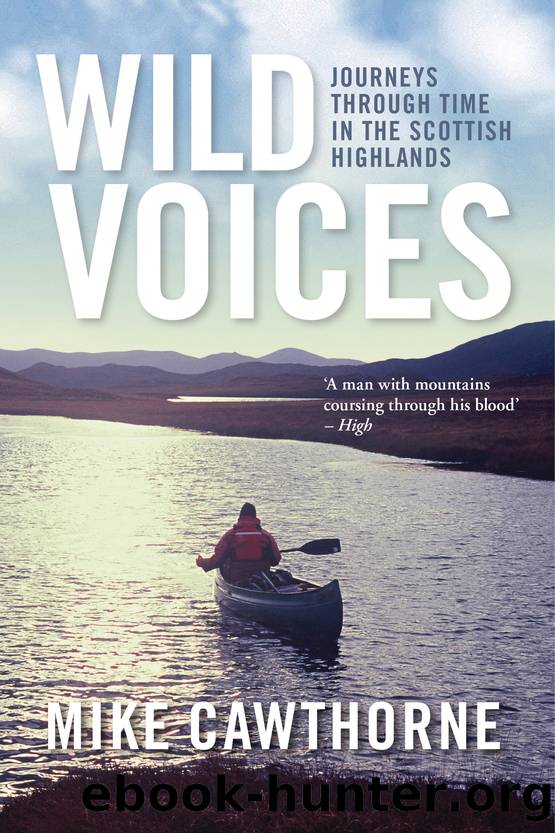
Author:Mike Cawthorne
Language: eng
Format: epub
Publisher: Birlinn
Secret Waters
Leaving the stone circle at Calanais you could walk south and west for days and not see a house or cross a road, in a journey of lochs and low hills and peatlands that ends, if you so choose, at some raised beach by the Atlantic. Human echoes are found in placenames â Norse overlapping with Gaelic â in moss-covered cairns and dolmen stones and where old causeways cross loch and channel. I remember the moment I first saw this land for myself. Our boat moored at Tarbert, weâd gone up Clisham to escape the sultry air of that rare phenomenon, a Hebridean heatwave. From the summit we surveyed the aquamarine waters and white sands of the Sound of Taransay, swinging our gaze over the hills of Teileasbhal and Stulabhal to the curving finger of Loch Langabhat. At its tip the land opened to a strange piedmont half drowned in lochs and with gnarly hillocks among them like old magma come to the surface. Naturally I wanted to go there, but how? There was so much water.
The lochans of the Outer Hebrides were the first to interest me in the use of a canoe to explore such places and initially, with the map spread, I conceived an east-west route, effectively a crossing of Lewis by canoe. It was something of a grand gesture and a younger self would have left it at that and made preparations; but increasingly I saw the land-locked waters northeast of Langabhat as a world in itself.
Iâd never before seen a system like it, an almost bewildering arrangement and I struggled to see a beginning. At first it seemed I was looking at a random scattering of lochs where natural dips and hollows in the gneiss bedrock had flooded after the last glaciation, but it was more that my map failed to present a deeper truth. Maybe the scale was wrong. It is strange to be able to cover a crooked mile of loch shore with your thumb, yet know nothing of its reality on the ground. Maps struggle to reveal more. They show composites â a hill but not a single rock, a burn though not its eddies or pools or where it runs deep or thinly over boiler plates. They caption a place, no more. I often think that I might one day do without maps altogether, finding my way from memory and the old clues of nature. How much more magical and fresh would places then appear.
Download
This site does not store any files on its server. We only index and link to content provided by other sites. Please contact the content providers to delete copyright contents if any and email us, we'll remove relevant links or contents immediately.
The Vikings: Conquering England, France, and Ireland by Wernick Robert(84374)
Ali Pasha, Lion of Ioannina by Eugenia Russell & Eugenia Russell(40315)
The Conquerors (The Winning of America Series Book 3) by Eckert Allan W(37892)
The Vikings: Discoverers of a New World by Wernick Robert(37006)
Cecilia; Or, Memoirs of an Heiress — Volume 1 by Fanny Burney(32635)
Cecilia; Or, Memoirs of an Heiress — Volume 2 by Fanny Burney(32010)
Cecilia; Or, Memoirs of an Heiress — Volume 3 by Fanny Burney(31996)
Empire of the Sikhs by Patwant Singh(23135)
The Secret History by Donna Tartt(19291)
Hans Sturm: A Soldier's Odyssey on the Eastern Front by Gordon Williamson(18648)
Cat's cradle by Kurt Vonnegut(15441)
Pimp by Iceberg Slim(14661)
Sapiens: A Brief History of Humankind by Yuval Noah Harari(14458)
Norse Mythology by Gaiman Neil(13457)
Talking to Strangers by Malcolm Gladwell(13438)
Leonardo da Vinci by Walter Isaacson(13407)
4 3 2 1: A Novel by Paul Auster(12505)
Underground: A Human History of the Worlds Beneath Our Feet by Will Hunt(12144)
The Radium Girls by Kate Moore(12089)
